
Rowing Machine vs Other Cardio Equipment: Which Fits Your Home Gym Best?
Rowing machine vs cardio equipment is not a question of which machine is “best” on paper. The better question is: which one fits your room, your joints, your training goal, and the way you actually exercise after the first two weeks?
This guide compares the rowing machine, treadmill, elliptical, and exercise bike from a home-gym buyer’s point of view: space, workout effect, joint pressure, noise, budget, maintenance, and long-term use.
Table of Contents
Rowing Machine vs Cardio Equipment: What Are You Actually Comparing?
A rowing machine vs cardio equipment comparison becomes easier when you stop comparing machine names and start comparing trade-offs.
A rowing machine trains the legs, hips, core, back, and arms in one movement. It can work well for people who want full-body cardio but do not want a large treadmill in the room.
A treadmill is the most familiar choice. Walking and running feel natural, but impact, motor noise, and floor space matter more at home than they do in a commercial gym.
An elliptical gives low-impact movement with a guided stride. It can feel easier on the joints than running, but many models take up more vertical and floor space than buyers expect.
An exercise bike is usually the easiest machine to place in a small room. It is quiet, simple to use, and beginner-friendly, but it mainly trains the lower body.
For general health, the CDC adult physical activity guidelines recommend weekly aerobic activity plus muscle-strengthening work. That matters here because the best cardio machine for home gym use is the one that helps you train consistently, not the one with the biggest console.
Which Cardio Machine Works Better in a Small Home Gym?
For small rooms, rowing machine vs cardio equipment often comes down to footprint and storage.
A treadmill usually needs the most permanent space. Folding helps, but the machine is still heavy and not always easy to move. An elliptical also needs a stable footprint and enough ceiling height for the user’s movement.
An exercise bike is usually the easiest to fit beside a desk, bed, or wall. A rowing machine is longer during use, but some models can be stored upright or moved after training.
| Equipment | Space Reality at Home |
|---|---|
| Rowing machine | Long during use, often easier to store upright |
| Treadmill | Large footprint, heavy even when folded |
| Elliptical | Wide and tall, needs ceiling clearance |
| Exercise bike | Smallest footprint for most homes |
If you live in an apartment, do not only measure floor length. Check where the machine goes when not in use, how easy it is to move, and whether other family members need the same space.
The shift toward compact home fitness setups is also discussed in this article on home cardio equipment trends, especially where buyers want one machine to do more than basic steady cardio.
Rowing Machine vs Treadmill vs Elliptical: Which Is Easier on the Knees?
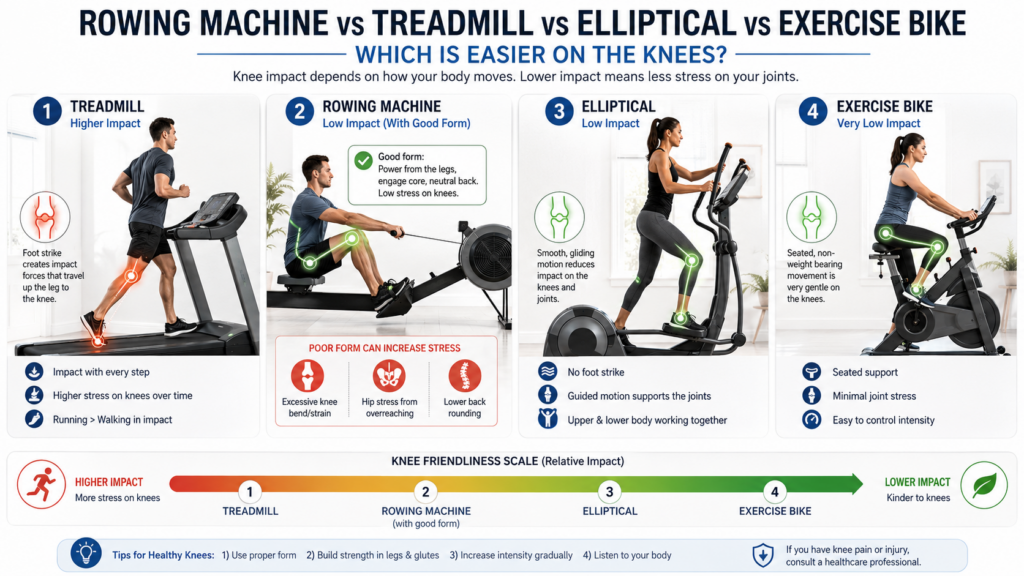
Rowing machine vs cardio equipment for joint pressure is not as simple as “low impact equals safe.”
A treadmill can be fine for walking, but running creates repeated impact. For people with sensitive knees, that may become a problem if volume increases too quickly.
A rowing machine has low impact because the user is seated, but poor technique can shift stress to the lower back, hips, or knees. Good form matters.
An elliptical is often used by people who want a guided, low-impact stride. Mayo Clinic notes that elliptical trainers can provide low-impact workouts, and some models involve both arms and legs.
An exercise bike can also be joint-friendly, especially for steady cardio. Mayo Clinic’s arthritis exercise guidance mentions stationary or recumbent bicycling and elliptical workouts as lower-impact options for joints.
The practical rule: if your knees are the main concern, do not choose by calorie claims. Choose by movement comfort, seat or foot position, resistance control, and whether you can train without pain the next day.
Which Machine Gives a Better Full-Body Workout?
Rowing machine vs cardio equipment becomes interesting when the goal is more than “get sweaty.”
A rowing machine uses the legs to drive, the core to transfer power, and the upper body to finish the stroke. That gives it an advantage for people who want cardio with more muscle involvement.
A treadmill is excellent for walking and running fitness. It is direct, familiar, and easy to progress with speed or incline. But it does not train the upper body much.
An elliptical can involve the arms if the user actively pushes and pulls the handles. If the handles are used passively, the workout becomes mostly lower-body.
An exercise bike is strong for steady cardio, intervals, and beginner consistency. It is not the best choice if the buyer wants one machine to involve the whole body.
For rowing form, the Concept2 indoor rowing technique guide breaks the stroke into the drive and recovery. That is useful because a rowing machine only delivers its best value when the user learns the movement instead of pulling with the arms first.
What Is the Best Cardio Machine for Weight Loss at Home?
A rowing machine vs cardio equipment debate often turns into a calorie debate, but that can mislead buyers.
Weight loss depends on workout intensity, weekly frequency, diet, recovery, and whether the machine gets used regularly. A treadmill can burn a lot of energy if you run. A rowing machine can support hard intervals. An exercise bike can help beginners build a habit. An elliptical can give steady cardio with lower impact.
The American Heart Association target heart rate guide explains that moderate-intensity activity is generally around 50–70% of maximum heart rate, while vigorous activity is higher. That is a better way to judge effort than assuming one machine always burns more.
Use this buying logic:
- If you enjoy running, a treadmill may keep you consistent.
- If you want full-body intervals, a rowing machine is a strong option.
- If your joints dislike impact, an elliptical or bike may be easier to maintain.
- If you are a beginner, the machine you can use four times a week matters more than the hardest machine.
Which Cardio Equipment Is Quiet Enough for Home Use?
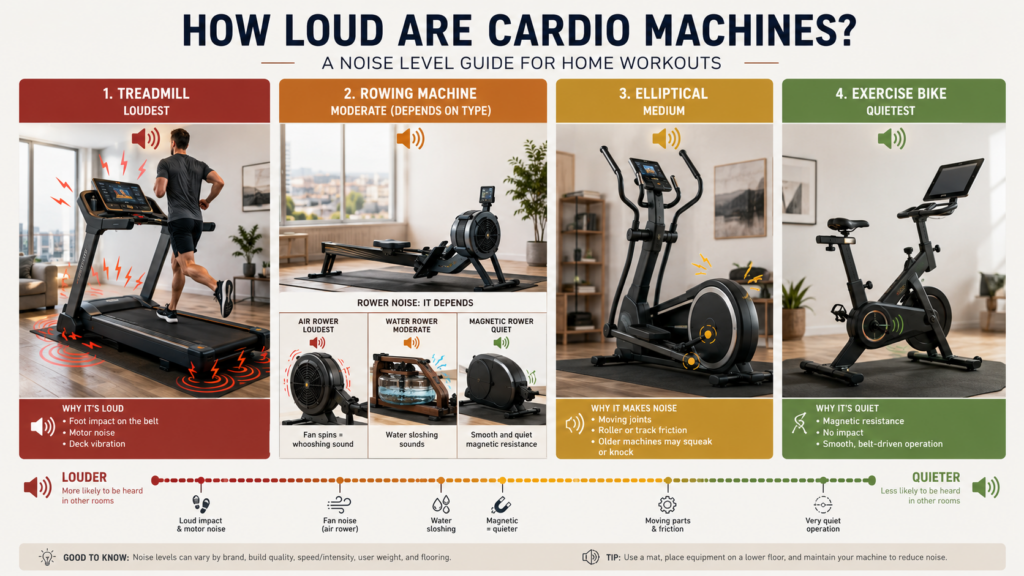
Rowing machine vs cardio equipment for noise depends on the resistance system and the building you live in.
Treadmills often create the most noticeable home noise because of foot strike and motor sound. This can be an issue in apartments or upstairs rooms.
Exercise bikes are usually the quietest, especially magnetic-resistance models. They are easier to use early in the morning or at night.
Rowing machines vary. Air rowers make fan noise. Water rowers have water sound. Magnetic rowers are usually quieter. Ellipticals sit in the middle; a well-built unit can be quiet, but older moving parts may squeak or knock.
Which One Costs More After You Buy It?
Rowing machine vs cardio equipment should include upkeep, not only the sticker price.
Treadmills may need belt care, motor attention, floor protection, and more repair planning over time. Ellipticals have many moving joints, so frame noise and lubrication can matter. Exercise bikes are usually simpler, but seat comfort, pedals, and resistance systems still affect long-term use.
Rowing machines vary by resistance type. Some need rail cleaning, chain care, tank care, or monitor maintenance depending on design.
| Equipment | Cost Buyers Often Forget |
|---|---|
| Rowing machine | Rail cleaning, resistance care, storage space |
| Treadmill | Belt maintenance, motor wear, floor mat |
| Elliptical | Moving parts, frame noise, lubrication |
| Exercise bike | Seat comfort, pedals, resistance wear |
If a rowing machine already looks like the best fit for your space and training goal, this rowing machine buying guide can help you compare resistance type, frame design, monitor functions, and home-use details before choosing a model.
Which Machine Are You More Likely to Keep Using?
The most overlooked part of rowing machine vs cardio equipment is habit.
People often buy for ambition and quit because the machine does not match daily life. A treadmill is not useful if the noise stops you from using it. A rower is not useful if you never learn the stroke. An elliptical is not useful if it takes over the room. A bike is not useful if you find it boring after ten minutes.
Ask these questions before buying:
1.Do you prefer sitting, running, or standing movement?
2.Will the machine stay accessible, or will it be folded away and forgotten?
3.Can other family members adjust it easily?
4.Is the noise acceptable in your home?
5.Do you want full-body training or simple steady cardio?
6.Are your knees, hips, or back sensitive to certain movements?
A good home gym setup is not built around the most intense machine. It is built around the machine you will use without negotiating with your room, schedule, or body every time.
Which Cardio Machine Should You Choose?
This table is not a final rule, but it helps narrow the choice.
| Your Situation | Better Fit |
|---|---|
| You want full-body cardio | Rowing machine |
| You love walking or running | Treadmill |
| You want low-impact steady movement | Elliptical |
| You want quiet beginner cardio | Exercise bike |
| You live in a small apartment | Exercise bike or foldable rower |
| You want hard intervals | Rowing machine or treadmill |
| You have knee concerns | Bike, elliptical, or rower with correct form |
| You want the simplest setup | Exercise bike |
Rowing machine vs cardio equipment should not end with one winner. A rowing machine makes sense when you want full-body cardio, lower impact, and a machine that can fit into a compact home gym plan. A treadmill makes sense when running or walking is the habit you will keep. An elliptical works when low-impact standing movement feels better. An exercise bike is hard to beat for quiet, simple, beginner-friendly cardio.
The best home gym setup is the one that matches your space, joints, noise limits, budget, and routine. That is the real answer behind rowing machine vs cardio equipment.
FAQ
Is a rowing machine better than a treadmill for home use?
Not always. A rowing machine is better for full-body, low-impact cardio. A treadmill is better if you enjoy walking or running and have enough space.
Which is better: rowing machine vs treadmill vs elliptical?
It depends on your goal. Rowing is more full-body. Treadmill training is best for running or walking. Elliptical training is useful for low-impact steady cardio.
What is the best cardio machine for home gym use?
For small spaces, an exercise bike or foldable rowing machine often works well. For running, choose a treadmill. For low-impact standing movement, choose an elliptical.
Is a rowing machine good for weight loss?
Yes, if used consistently with enough intensity. Weight loss still depends on training frequency, diet, recovery, and long-term habits.
Is a rowing machine bad for knees?
Usually no, because it is low impact. Poor setup or technique can still cause discomfort, so start with low resistance and learn the stroke.
Which cardio equipment is quietest for apartments?
An exercise bike is usually the quietest. A magnetic rowing machine can also be quiet. Treadmills are usually the loudest because of foot impact.
Should beginners buy a rowing machine or exercise bike?
Choose an exercise bike if you want the easiest start. Choose a rowing machine if you want full-body cardio and are willing to learn proper technique.