
Table of Contents
Introduction
When you walk into any gym, the Smith Press Training Rack is almost always there. Yet, it often sits in the shadow of the free weight racks, sometimes misunderstood or prematurely dismissed by experienced lifters. While it lacks the stabilizing demand of a free barbell, this machine is far more than just a beginner’s toy. It is a powerful, specialized tool for anyone looking to maximize muscle stimulus, safely push boundaries, or effectively isolate a muscle group.
The fixed plane of motion offered by the Smith Press Training Rack is its greatest asset. This feature contributes to two major advantages:
- Unmatched Safety: The integrated safety catches allow you to train heavy, even to muscle failure, without the immediate need for a spotter. This is invaluable for pushing past plateaus safely.
- Laser-Focus Isolation: By minimizing the need for small stabilizer muscles to control the bar path, you can place near-total focus on the target muscle, creating a highly specific stimulus for growth.
In this article, we will go beyond the basics. We’ll break down five high-efficiency exercises that utilize the unique geometry and safety features of the Smith Press Training Rack to help you build strength, power, and muscle definition across your entire body.
5 High-Efficiency Smith Press Training Rack Exercises
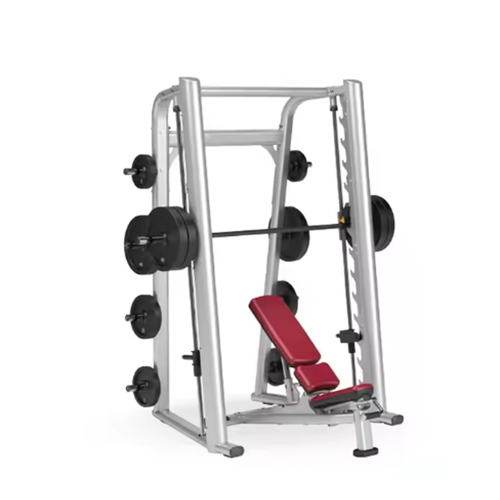
These five movements are selected for their effectiveness in maximizing muscle recruitment when performed within the fixed path of the Smith Press Training Rack.
Exercise 1: Smith Machine Squat (Quad-Focused Variation)
The squat is the king of lower body movements, but the Smith Press Training Rack allows you to manipulate your foot position to place extraordinary emphasis on the quadriceps.
To achieve this quad-dominant focus, position your feet slightly forward of the bar. This vertical bar path then forces your knees to track forward, placing maximum tension directly onto the quads. Remember, you are leveraging the machine’s stability to dial in this specific muscular tension.
| Muscle Group | Primary Focus | Smith Machine Advantage | Key Technique Tip |
| Lower Body | Quadriceps | Allows precise foot positioning to shift emphasis from glutes to quads. | Position feet slightly forward of the bar to drive maximum knee travel. |
| Upper Body | Chest, Triceps | Inherent safety allows for training closer to failure without a spotter. | Set safety pins just below the sticking point of your rep range. |
| Back | Lats, Upper Back | Excellent bodyweight variation to build mind-muscle connection and scapular retraction. | Adjust bar height to challenge your chosen rep range; keep the body straight. |
Exercise 2: Smith Machine Incline Press
While the flat bench press on the Smith Press Training Rack is popular, the incline press is a superior choice for many lifters focused on aesthetics and upper chest development. Research suggests that a moderate incline is highly effective for maximizing activation in the clavicular head of the pectoralis major (upper chest).
The fixed path is particularly beneficial here, as it simplifies the complex motor pattern of free-weight incline pressing. This allows you to truly focus on driving the weight through the upper chest and triceps. Ensure the bar is lowered to the upper chest area and that your shoulders remain retracted and stable on the bench.
Exercise 3: Smith Machine Stiff-Legged Deadlift
The stiff-legged deadlift is a powerhouse for developing the posterior chain, particularly the hamstrings and glutes. Unlike a conventional free-weight deadlift where stability is paramount, using the Smith Press Training Rack allows for hyper-focus on the hip-hinge movement.
Maintain a slight, fixed bend in your knees throughout the movement. The exercise is performed by pushing your hips backward as you lower the bar, feeling a deep stretch in the hamstrings. The bar moves on a perfect vertical path, ensuring that the tension remains isolated to the hamstring and glute tie-in, a crucial area for development. This fixed path minimizes potential lower back rounding due to instability.
Exercise 4: Smith Machine Overhead Press (Standing)
A standing overhead press is demanding, requiring tremendous core and lower body stabilization. By using the Smith Press Training Rack, you can significantly reduce the stability demands, allowing you to move heavier weight and place greater mechanical stress on the deltoids (shoulders).
When performing this movement, the critical technique tip is to actively engage your core and glutes to prevent excessive hyperextension of the lower back. The fixed path lets you drive the bar straight up without needing to compensate for forward or backward drift, isolating the anterior and medial deltoid heads.
Exercise 5: Smith Machine Inverted Row (High Position)
This exercise, sometimes called a bodyweight row, is frequently overlooked but provides exceptional value. It is arguably the most effective way for a beginner to build the mind-muscle connection necessary for back development, and it is a phenomenal finisher for experienced lifters.
Adjust the bar to a height that allows you to complete your desired number of repetitions (a higher bar is easier, a lower bar is harder). Grab the bar and position your body so that your head, hips, and heels form a straight line. Focus intensely on pulling your shoulder blades together and driving your elbows down toward your hips. This movement teaches essential scapular retraction and recruitment of the latissimus dorsi without the grip limitations often associated with pull-ups.
Safety and Efficiency Principles for the Smith Press
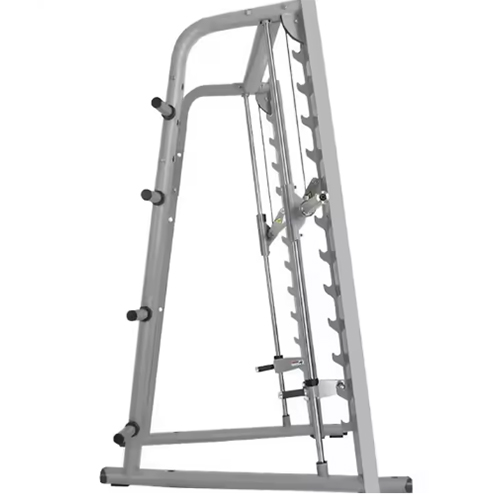
To truly leverage the power of the Smith Press Training Rack, you must adhere to best practices that balance its safety features with your training intensity.
- Master the Lockouts: The twist-lock mechanism is your emergency brake. Before every set, familiarize yourself with the turning direction and practice locking the bar. Always set the physical safety stops/pins to a height just below the bottom of your intended range of motion. This is non-negotiable, particularly when training to failure.
- The Angle of the Rack: Be aware that some Smith Press Training Racks are engineered with a slight angle (usually 7 to 12 degrees). Always check your machine. If it is angled, choose the direction that feels most biomechanically natural for your movement. For most movements like the squat and press, facing the angle ensures the bar travels slightly backward relative to your body, promoting a safer lifting posture.
- Prioritize the Eccentric: Given the stability of the machine, the Smith Press Training Rack is excellent for emphasizing the eccentric (lowering) phase of a lift. Slow down your negative repetitions (e.g., 3-4 seconds down) to induce greater microtrauma and subsequent muscle growth. This technique is often cited in sports science literature as a key mechanism for hypertrophy.
Conclusion
The Smith Press Training Rack is a valuable, specialized piece of equipment that, when used correctly, can enhance your training safety, increase muscle isolation, and help you overcome plateaus. It should not be viewed as a mere replacement for free weights but as a targeted tool in your arsenal. By incorporating these five high-efficiency movements—the Quad-Focused Squat, the Incline Press, the Stiff-Legged Deadlift, the Overhead Press, and the Inverted Row—into your routine, you can maximize the potential of the Smith Press Training Rack and ensure every rep contributes to a precise training stimulus.
We encourage you to experiment with your foot placement on the squat and your grip width on the press to find the exact setup that maximizes the feeling of your target muscle working.
FAQ
Is the Smith Press Training Rack only for beginners?
No. While it’s great for beginners to learn movement patterns safely, experienced lifters use it for isolation, hitting muscle failure, and safely performing negative reps due to its built-in safety mechanisms.
How do I set the safety catches on a Smith Press Training Rack?
Always set the physical safety pins/catches just below your lowest point of movement. This ensures that if you fail a lift, the bar will rest safely on the pins, not on your body.
Should I face toward or away from the machine’s angle when squatting?
If the machine has a slight angle (most do), you should generally face the direction where the bar travels slightly backward relative to your body on the way up, as this mimics the natural path of a free-weight squat.
What is the main benefit of the fixed bar path?
The main benefit is enhanced muscle isolation. The fixed path reduces the need for stabilizing muscles, allowing you to place maximum, targeted tension on the primary muscle group you are trying to develop.
Ready to maximize your muscle growth and train safer?
If you’re still uncertain about how to best integrate the Smith Press Training Rack into your routine, or which specific model is right for your home gym setup, our training specialists are ready to assist you. Contact us today for a personalized equipment consultation to match you with the perfect gear.