
Walk into any commercial gym, and you’ll see rows of people mindlessly gliding on elliptical trainers while watching Netflix. To the casual observer, it looks like a low-intensity “recovery” tool—a way to move without the impact of a treadmill. There is a persistent myth in the fitness community that this machine is purely for cardio and “only works the legs.”
The reality is far more interesting. If you understand the muscles worked by elliptical training, you realize it is one of the most versatile pieces of equipment for total-body hypertrophy and functional toning. By manipulating your posture, resistance, and direction, you can transform a steady-state cardio session into a comprehensive resistance workout.
But why do so many people miss out on these gains? Usually, it’s a lack of intent. To get the most out of your time, you need a blueprint of exactly which fibers are firing.
Table of Contents
Lower Body Powerhouse
The foundation of any elliptical session is the lower body. Because your feet never leave the pedals, you eliminate the jarring impact on joints, but you don’t eliminate the workload. Understanding the muscles worked by elliptical sessions starts with the “Big Three” of the lower chain: the quadriceps, hamstrings, and glutes.
When you push the pedal down and forward, your quadriceps take the brunt of the force. However, the real “secret sauce” for many users is the glutes and legs workout potential during the pull-back phase. Unlike a treadmill, where the belt moves under you, the elliptical requires you to actively pull the pedal through the arc.
If you want to focus on your posterior chain—specifically the glutes—try leaning back slightly and pushing through your heels rather than your toes. This shift in center of gravity forces the gluteus maximus to work harder during hip extension.
Upper Body Engagement: More Than Just Holding On
The most significant advantage of the elliptical over the stationary bike or treadmill is the inclusion of the movable handlebars. Yet, most people either let their arms hang limp or hold the stationary center bars. To maximize the muscles worked by elliptical hardware, you must actively push and pull.
This isn’t just about moving your arms; it’s about upper body engagement. When you push the handles forward, you are engaging your pectorals (chest) and anterior deltoids (front of the shoulders). When you pull the handles back, you are activating your rhomboids, latissimus dorsi (back), and biceps.
By consciously gripping the handles and putting force into the movement, you turn a leg-dominant exercise into a “push-pull” resistance circuit. This balanced workload increases your caloric burn and ensures that your metabolic rate stays elevated long after you leave the gym.
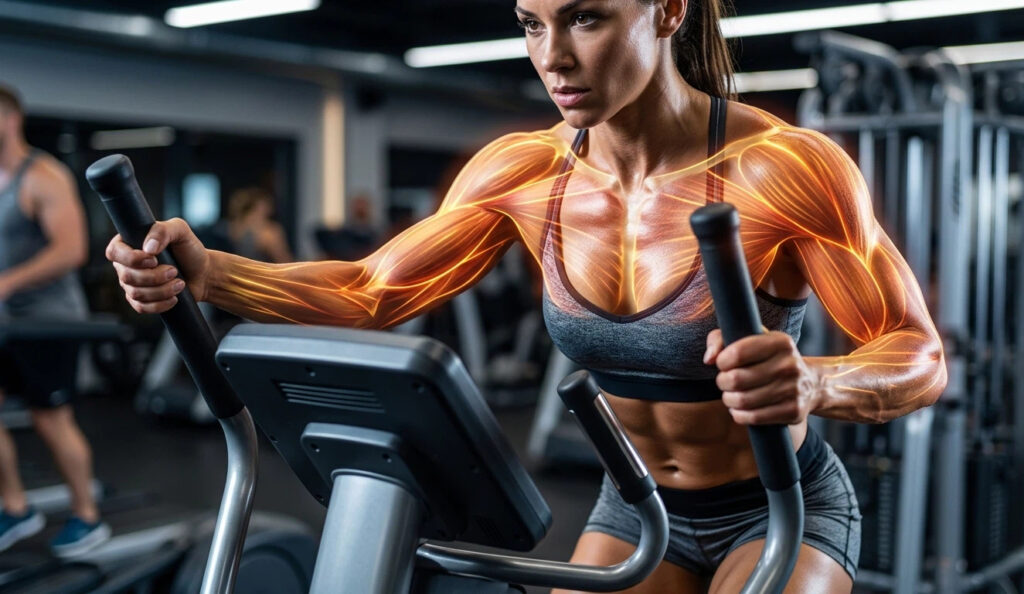
The Question: What muscles does an elliptical machine target? (With Diagrams)
If we were to look at a comprehensive list of muscles worked by elliptical movement, we would see a nearly 80/20 split between the lower and upper body if used correctly. Most enthusiasts ask: What muscles does an elliptical machine target? .
Beyond the obvious limbs, the “hidden” worker here is your core. Your obliques and transverse abdominis are constantly firing to stabilize your torso as your arms and legs move in opposite directions. This rotational stability is key for athletes and everyday functional health.
To prove the efficiency of this machine, let’s look at how it compares to other common gym staples regarding specific muscle group activation.
Muscle Activation Comparison Table
| Muscle Group | Elliptical (High Resistance) | Treadmill (Incline) | Stationary Bike |
| Quadriceps | High | High | Very High |
| Glutes | High (Reverse pedal) | High | Medium |
| Hamstrings | Medium/High | Medium | Low |
| Chest/Back | High (with handles) | None | None |
| Core | High (No hands) | Medium | Low |
The Science of Resistance and Posture
The degree of the muscles worked by elliptical resistance depends heavily on your settings. If the resistance is too low, you are simply using momentum, which provides zero muscle-building stimulus. To trigger hypertrophy, you must set the resistance high enough that your heart rate climbs and your muscles feel a “burn” within 2 to 3 minutes.
Specifically, the muscles worked by elliptical machines are heavily influenced by the incline. Increasing the incline doesn’t just make it “harder”; it changes the biomechanics. A higher incline mimics a stepping motion, shifting the load heavily toward the glutes and hamstrings. A lower incline, or a flatter stride, tends to focus more on the quadriceps and calves.
The Power of Reverse Pedaling
One of the most underutilized techniques to diversify the muscles worked by elliptical trainers is going in reverse. Most cardio machines only allow for one-directional movement. However, by pedaling backward on an elliptical, you drastically increase the activation of the hamstrings and calves.
A study focusing on muscles worked by elliptical exercise published in the Journal of Strength and Conditioning Research found that backward pedaling produced higher electromyographic (EMG) activity in the quadriceps and heart rate responses compared to forward pedaling at the same intensity. You can find more on their biomechanical research here: NSCA – Journal of Strength and Conditioning Research.
By alternating 5 minutes forward and 5 minutes backward, you ensure that no muscle in the lower body is left dormant.
Pro Tips for Total Body Sculpting
To target more muscles worked by elliptical routines, consider these three “Expert Level” tweaks:
1.The No-Hands Challenge: Let go of the handles and keep your arms at your sides (like you’re running). This forces your core to work overtime to keep you balanced on the moving pedals.
2.The Squat Glide: Lower your hips into a semi-squat position while pedaling. This creates an intense glutes and legs workout that mimics a wall-sit while in motion.
3.The Sprint Interval: Increase the resistance to 75% of max and “sprint” for 30 seconds while focusing exclusively on the “pull” of the handles. This targets the upper back and lats.
Conclusion
The final thoughts on the muscles worked by elliptical efficiency come down to one thing: intensity. If you treat the machine as a casual walk, it will provide casual results. But if you view it as a total-body resistance tool, it becomes an indispensable part of a sculpting routine.
By focusing on upper body engagement and utilizing a glutes and legs workout through reverse pedaling and incline changes, you move beyond simple cardio. Stop just “moving” on the machine and start training on it. Your joints—and your mirror—will thank you.
FAQ
What are the main muscles worked by elliptical trainers?
The primary focus is the quadriceps, glutes, and hamstrings, but if you use the handles, you also engage the chest, back, biceps, and triceps.
Does the elliptical help with belly fat?
While you can’t spot-reduce fat, the elliptical is a high-calorie burner. By engaging more muscle groups, you increase your basal metabolic rate (BMR), which helps with overall fat loss.
How many days a week should I use the elliptical for muscle tone?
For visible results, aim for 3 to 4 sessions per week, focusing on high-resistance intervals rather than long, slow “gliding.”
Is the elliptical better than running for glutes?
It can be. Because you can pedal in reverse and use high incline settings, you can often target the glutes more directly than flat-ground running, all without the impact on your knees.