
The debate surrounding front drive vs rear drive elliptical systems often centers on personal preference, yet the true distinction lies in the underlying physics of motion. For professional gym owners and biomechanics-conscious users, choosing a drive system is not merely about where the flywheel sits; it is an analysis of how mechanical pivots dictate human kinetic alignment. The placement of the drive housing fundamentally alters the shape of the elliptical path, shifting the load between the quadriceps, gluteals, and the patellofemoral joint.
Understanding the core differences between a front drive vs rear drive elliptical is essential for anyone prioritizing long-term joint health and movement efficiency. While both designs aim to provide a low-impact alternative to running, they achieve this through vastly different linkage geometries. In this technical dissection, we will break down the “ellipse” itself, exploring how the drive position influences the kinetic chain and determines which elliptical drive system is best for natural running motion.
Table of Contents
The Geometry of the Ellipse: Stride Path Mechanics
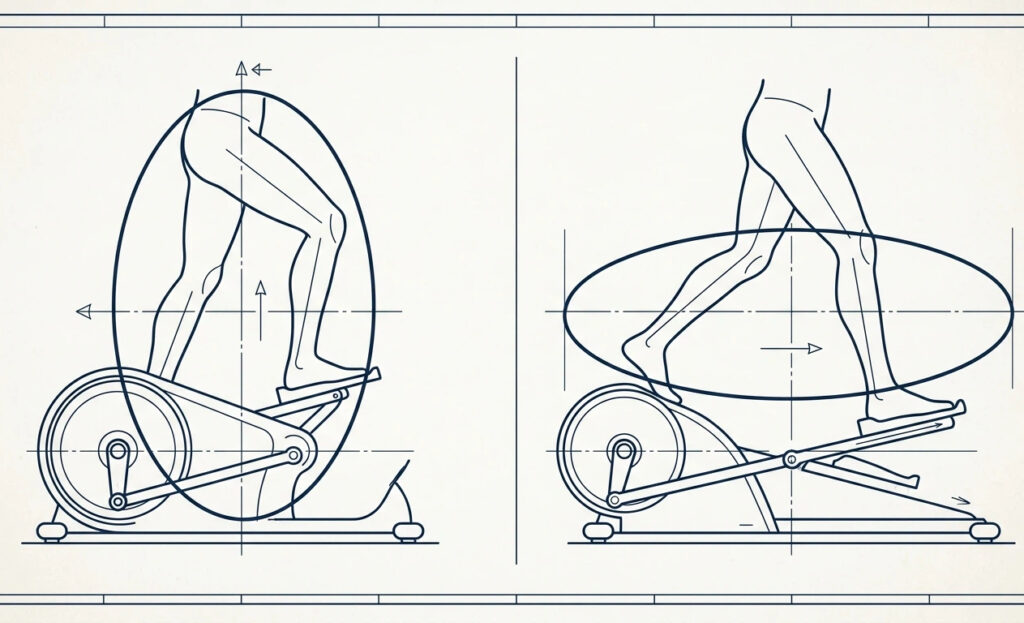
The most immediate difference in front drive vs rear drive elliptical design is the shape of the movement. Front-drive machines, which utilize a flywheel at the front connected to pedals moving along a track, tend to produce a more vertical, “stepper-like” motion. This is because the pivot point is positioned ahead of the user’s center of mass, forcing a higher knee lift during the recovery phase of the stride.
Conversely, a rear-drive system positions the flywheel behind the user, typically utilizing a long-arm linkage. This allows for a much flatter, elongated ellipse. When we analyze elliptical stride mechanics, the rear-drive path more closely mimics the natural extension of the hip and ankle found in high-performance running. For users seeking to replicate a sprinting or jogging gait, the rear-drive architecture provides a superior “heel-to-toe” rolling action.
However, the verticality of a front drive vs rear drive elliptical isn’t necessarily a flaw. Front-drive units often facilitate a more intense workout for the quadriceps and are frequently equipped with “Power Incline” features. By raising the tracks, these machines can shift the workout from a flat run to a steep climb, targeting the glutes and hamstrings in a way that traditional rear-drive machines cannot easily replicate without significant mechanical complexity.
Biomechanics of Joint Loading and Patellar Pressure
When evaluating a front drive vs rear drive elliptical, the impact on the knee joint is a primary concern for professional buyers. Because front-drive machines often have a more circular path, they can induce more significant knee flexion (bending). For individuals with existing patellofemoral pain, this increased flexion can lead to higher compressive forces behind the kneecap.
Authority Reference: Research published by the American Council on Exercise (ACE) suggests that while ellipticals significantly reduce ground reaction forces compared to running, the specific kinematics of the machine—such as pedal articulation and stride height—play a critical role in joint torque.
In a front drive vs rear drive elliptical comparison, the rear-drive system often allows the foot to remain flatter for longer. This reduces the premature “toe-push” that beginners often fall into on front-drive machines. By maintaining a more neutral ankle position, the rear-drive system mitigates excessive strain on the Achilles tendon and the plantar fascia, making it a strong contender when deciding which elliptical drive system is best for natural running motion.
Q-Factor and Pelvic Alignment
One of the most overlooked technical specifications in the front drive vs rear drive elliptical debate is the “Q-Factor”—the horizontal distance between the pedals. In biomechanics, a narrow Q-Factor is generally preferred as it keeps the hips, knees, and ankles in a straight, neutral line. This prevents the “duck walk” or excessive lateral swaying of the pelvis.
Rear-drive machines traditionally have an advantage here. Because the flywheel and drive housing are located behind the user, the space between the pedals can be kept very narrow. In many high-end rear-drive units, the Q-Factor is less than 2 inches. On a front drive vs rear drive elliptical, the front-drive unit must often place the pedals on either side of the wide drive housing or the support tracks, which can sometimes result in a wider, less ergonomic stance.
For a professional buyer, the Q-Factor is a non-negotiable metric. A wide stance can lead to IT band syndrome or hip bursitis over time. When analyzing elliptical stride mechanics, ensure that the machine allows for a foot position that mimics the natural stance width of a person walking or running on a track.
Inertia, Momentum, and Resistance Curves
The sensation of “smoothness” in a front drive vs rear drive elliptical is a product of the flywheel’s moment of inertia. Rear-drive systems, due to their long-arm linkage, often provide a more consistent momentum. The weight of the user’s body works with the long lever arms to maintain a steady speed, preventing the “dead spot” at the top and bottom of the stroke.
Front-drive machines rely heavily on the weight of the flywheel to overcome the friction of the rollers on the tracks. If the tracks are not perfectly clean or if the rollers are worn, the front drive vs rear drive elliptical experience becomes noticeably different, with the front-drive machine feeling “stiff” or “jerky.” However, modern high-end front-drive units utilize heavy, perimeter-weighted flywheels to counteract this effect, providing a very smooth ascent during incline training.
For commercial facilities, the maintenance ROI of a front drive vs rear drive elliptical must be considered. Front-drive machines have exposed tracks and rollers that require frequent cleaning to prevent noise and vibration. Rear-drive systems are often “suspended” or enclosed, reducing the accumulation of dust and debris in the moving parts, which translates to lower long-term service costs for high-traffic gyms.
Choosing for the End-User
Ultimately, determining which elliptical drive system is best for natural running motion depends on the specific goals of the athlete. If the goal is sports-specific cross-training for marathon runners, the rear-drive system’s horizontal, “gliding” motion is superior. It reinforces the hip extension required for a powerful running stride while keeping the impact levels at a minimum.
On the other hand, if the target demographic is focused on weight loss and high-intensity interval training (HIIT), a front drive vs rear drive elliptical with a power incline is often more effective. The ability to switch from a flat stride to a 20-degree incline allows the user to engage more muscle fibers in the posterior chain, increasing caloric burn without increasing perceived exertion.
The decision between a front drive vs rear drive elliptical should also account for the physical footprint of the equipment. Front-drive machines are generally more compact, making them ideal for boutique studios or home gyms where space is a premium. Rear-drive machines require more longitudinal space to accommodate the long linkage arms that facilitate that natural, elongated stride path.
Conclusion
Selecting a front drive vs rear drive elliptical is a decision that impacts user satisfaction, injury prevention, and equipment longevity. While front-drive machines offer versatility and space-saving designs, the rear-drive architecture remains the gold standard for those prioritizing a biomechanically accurate running gait. By focusing on elliptical stride mechanics and the specific needs of the kinetic chain, you can ensure that your equipment investment yields the best possible results for the athlete.
Whether you are outfitting a high-end rehabilitation center or a commercial fitness hub, the choice between a front drive vs rear drive elliptical should be rooted in data. Prioritize machines with a narrow Q-Factor, smooth inertial transitions, and a stride geometry that matches the intended movement profile. Achieving the “expert touch” in equipment selection requires looking beyond the aesthetics to the engineering that facilitates a truly natural running motion. In the end, the front drive vs rear drive elliptical that serves you best is the one that aligns with the natural mechanics of the human body.
FAQ
Which drive system is quieter for residential or hotel environments?
Generally, rear-drive systems are quieter over time. Front-drive units can develop “clicking” or “squeaking” sounds if the rollers and tracks are not meticulously maintained.
Is there a significant calorie burn difference in front drive vs rear drive elliptical models?
The drive position itself does not dictate calorie burn. However, front-drive machines with incline capabilities allow for higher intensity levels, which can lead to a higher metabolic demand compared to a flat-stride rear-drive machine.
Does drive position affect the durability of the electronics?
No, the electronics are typically isolated. However, on a front drive vs rear drive elliptical, the front-drive unit is more susceptible to sweat falling directly into the drive housing or onto the tracks, necessitating more frequent external cleaning.
Which system is better for users with balance issues?
Front-drive machines often feel more “contained” because the user is holding onto stationary handles that are closer to the drive housing. The more vertical motion can also feel more stable for those who find the long, horizontal glide of a rear-drive system to be “slippery.”