
Investing in home fitness equipment without auditing internal mechanical dimensions is a direct path to chronic joint discomfort and wasted capital. When auditing trainer specifications, the defining metric that governs your entire biomechanical alignment is the elliptical stride length. Buying a machine with an incorrect tracking dimension forces your lower body into an unnatural, restrictive pattern that severely limits caloric burn and risks localized muscle strain. This technical blueprint removes the guesswork by providing data-verified sizing frameworks, biomechanical risk analyses, and direct purchasing criteria to match your physical profile with the perfect home trainer.
Table of Contents
Why Calibrating Your Elliptical Stride Length Protects Your Joints and Progress
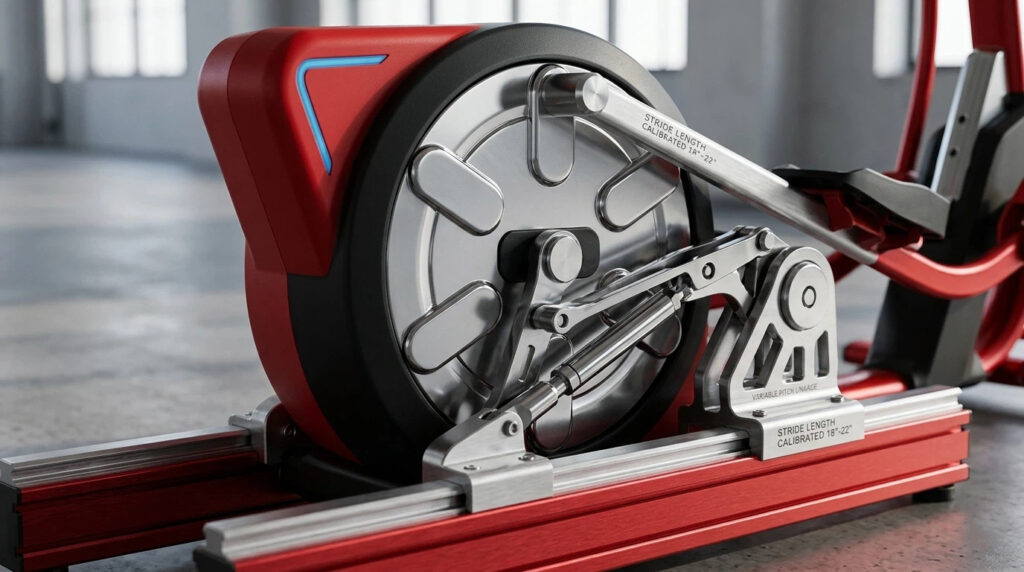
The physical distance between the heel of your front foot and the toe of your rear foot at the furthest points of the machine’s orbital rotation dictates your training economy. Failing to match this mechanical path to your body’s natural running gait creates immediate kinetic issues across your lower extremity chain. Adjusting your elliptical stride length is not about comfort; it is about joint preservation.
The Physiological Benefits of Optimal Stride Alignment
- Maximized Muscle Recruitment: When using a correct elliptical stride length, the hamstrings, gluteals, and quadriceps cycle through their full, natural range of motion, optimizing target muscle activation.
- Ergonomic Biomechanical Efficiency: A perfectly synced machine path mirrors human biomechanics, distributing mechanical load evenly across the hip and ankle complexes.
- Elevated Cardiovascular Output: Eliminating structural friction allows you to sustain higher strides-per-minute (SPM) thresholds, accelerating fat oxidation and metabolic output.
The consequences of choosing the wrong Elliptical stride length
- The Short-Stride Pitfall: If the orbital path is restricted, taller trainees experience a choppy, vertical bouncing sensation. This unnatural compression transfers excessive shearing force directly to the patellar tendon and meniscus.
- The Over-Extended Stride Pitfall: When shorter users operate an excessively wide orbital track, they are forced to over-reach. This over-extension causes the pelvis to tilt laterally to complete the rotation, causing acute lumbar strain and hip flexor irritation.
According to technical research on closed-kinetic-chain exercise parameters hosted by the National Center for Biotechnology Information (NCBI), restrictive linear constraints on an elliptical trainer significantly alter standard joint kinematics, making custom component matching vital for preventing chronic repetitive strain. To avoid these spatial conflicts, finding your baseline elliptical stride length must be your very first step before looking at brand names or tech consoles.
The Definitive Guide to Elliptical Stride Length by Height
To eliminate purchasing confusion, you must analyze a standardized biomechanical matrix rather than relying on generalized retail labeling. The structural chart below provides the baseline technical clearances required to preserve a fluent, low-impact stride path based on individual skeletal metrics.
| User Height (Imperial) | User Height (Metric) | Recommended Fixed Base Stride Length |
| Under 5’3″ | Under 160 cm | 16 Inches to 18 Inches |
| 5’3″ to 5’7″ | 160 cm to 170 cm | 18 Inches |
| 5’7″ to 6’0″ | 170 cm to 183 cm | 20 Inches |
| Over 6’0″ | Over 183 cm | 20 Inches to 22 Inches |
To map this to your unique structure, you can easily execute a diagnostic test to discover how to measure elliptical stride length at home. Step outside onto a level surface, execute 10 natural running strides at a moderate training pace, measure the total distance from your starting heel to your final landing point, and divide by 10. This number represents your baseline natural running gait, which should closely align with the fixed track dimension of your target equipment to ensure the chosen elliptical stride length supports your daily training volume.
Best Elliptical Stride Length for Tall Users Over 6 Feet
Suburban consumer fitness markets are saturated with compact, entry-level machinery utilizing standard 18-inch tracking systems. While these footprints conserve floor space, deploying them as the primary trainer for an athlete over six feet tall results in an ergonomically compromised workout. Finding the best elliptical stride length for tall users over 6 feet requires a minimum floor specification of a true 20-inch, or ideally a 22-inch, orbital track.
Biomechanical data from the American Council on Exercise (ACE) suggests that limiting an individual’s natural stride profile causes premature muscle fatigue and alters core stability metrics. For taller populations, an inadequate elliptical stride length forces a semi-squatted posture, overloading the quadriceps while completely disengaging the posterior chain muscles.
Adjustable Stride vs Fixed Stride: Is the Premium Hardware Worth the Investment?
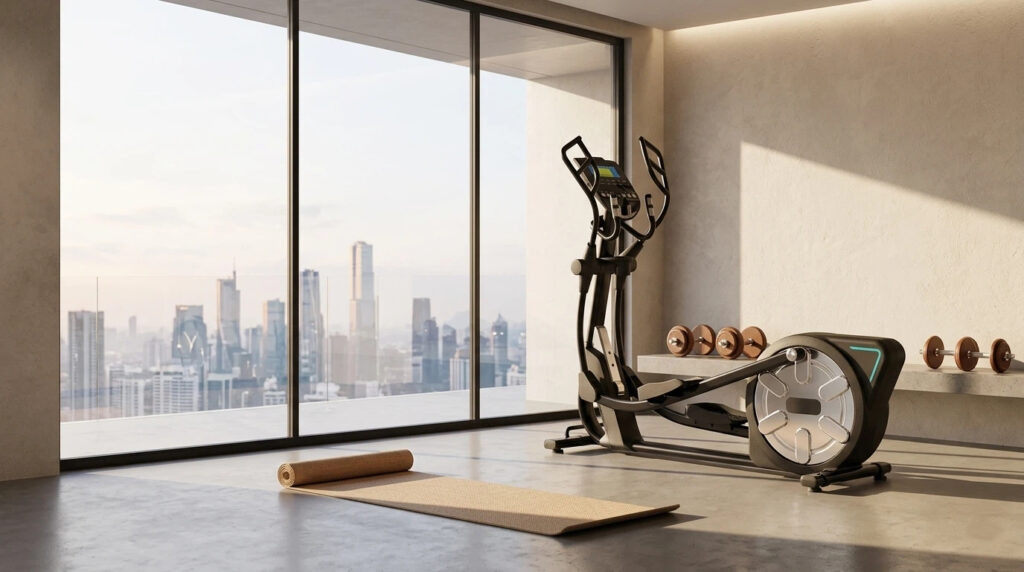
When auditing the marketplace, evaluating an adjustable stride vs fixed stride mechanism represents the primary pricing separator for residential machinery. This hardware engineering choice directly impacts how the user experiences their daily workout parameters.
Fixed track units utilize a welded steel linkage system attached to the drive wheel, securing the user into one unalterable parameter. While structurally rigid and cost-effective for single-user home setups, they lack the adaptability needed for multi-user households where heights vary drastically. In these scenarios, a locked elliptical stride length forces shorter or taller family members into a compromised movement path.
Conversely, integrating an automated or manual adjustable track system completely alters your training utility. Investing in an adjustable setup provides two structural advantages:
1.Multi-User Accommodation: A 5’2″ spouse and a 6’3″ partner can share a single asset without either person compromising their safety or biomechanical posture because the machine adjusts to their natural gait.
2.HIIT Routine Scaling: Shortening the machine’s linkage replicates a steep, vertical step-climbing motion targeting the gluteals, while extending the system to maximum capacity transforms the asset into a high-speed sprint simulator.
Engineering guides hosted by the Institution of Mechanical Engineers (IMechE) detail how multi-link variable path mechanisms reduce stress concentrations on rotational bearing points, proving that high-grade adjustable linkages improve component longevity alongside user ergonomics. No matter your budget, verifying how these mechanical linkages alter your active elliptical stride length is essential before completing your order.
Moving from Stride Metrics to Selecting the Perfect Elliptical Machine
Once you have identified your optimal metric, you can use your required elliptical stride length as a strategic filter to select the perfect elliptical machine for your home facility. The structural configuration of the machine’s drive engine directly shapes how that dimension feels during high-velocity use.
- Front-Drive Systems: These units feature the flywheel housing at the front of the frame, creating a linear, walking-style path. If you choose a front-drive chassis, ensure it includes dual articulated tracking rails to prevent your heels from lifting prematurely during the extension phase.
- Rear-Drive Systems: Positioned at the back of the chassis, rear-drive configurations deliver a centered, elliptical motion path that closely mimics a natural outdoor running stride. This layout is highly recommended for athletes prioritizing high-intensity running simulations.
- Center-Drive Compact Systems: By flanking the pedals with dual compact flywheels, center-drive designs offer the most compact frame footprints available while still delivering full 20-inch setups, making them the ultimate option for restricted urban floor plans.
Clinical guidelines regarding home exercise selection from the American College of Sports Medicine (ACSM) emphasize that equipment safety is optimized when the user’s natural center of gravity is maintained without vertical oscillation, a metric controlled entirely by how the drive configuration interacts with your target elliptical stride length.
Final Verdict
Never let structural aesthetics or retail discounts dictate your equipment purchases. Prioritizing your custom elliptical stride length is the only reliable way to protect your joints, maximize your training output, and secure an asset that delivers long-term utility. Whether you invest in a versatile adjustable linkage or source a precise fixed track, matching the machine’s dimensions to your physical profile is essential for a safe, low-impact workout. Review your vertical measurements, cross-reference them with our verified sizing matrix, and choose a drive configuration that supports your body’s natural stride mechanics.
FAQ
Can an incorrect elliptical stride length cause lower back pain?
Yes. Operating an overly long track forces your hips to rock laterally to reach the pedal apex, placing repetitive twisting stress on the lumbar spine and triggering deep lower back pain.
Is an adjustable stride elliptical worth the extra cost for a single user?
Yes, if your training program incorporates high-intensity interval training (HIIT). Changing the stride link lets you alternate between steep climbing motions and long sprinting strides on a single machine.
How do commercial health club ellipticals handle stride differences?
Most premium commercial club platforms utilize variable-sensing, friction-free floating linkages that automatically adjust to a user’s stride profile in real time without manual pin adjustments.