
In the evolving landscape of home and commercial fitness, the search for the most efficient, sustainable workout often leads back to one powerhouse: the elliptical cross-trainer. Unlike transient fitness fads, the elliptical machine benefits are grounded in biomechanical efficiency and cardiovascular science.
Whether you are a professional athlete recovering from an injury or a home user looking to maximize your “time-to-calorie” ratio, understanding the data behind this machine is crucial. Here is a technical breakdown of why the elliptical remains a cornerstone of modern exercise.
Table of Contents
Exceptional Low-Impact Aerobic Conditioning
The primary driver of the elliptical machine benefits is its “low-impact” nature. Unlike running, where each stride generates an impact force of up to 2.5 times your body weight, the elliptical maintains a closed-path kinetic chain.
This means your feet never leave the pedals, virtually eliminating the jarring impact on the ankles, knees, and hips. For individuals with chronic joint issues or those in post-surgical rehabilitation, it provides a high-intensity cardiovascular stimulus without the associated orthopedic stress.
True Full-Body Engagement
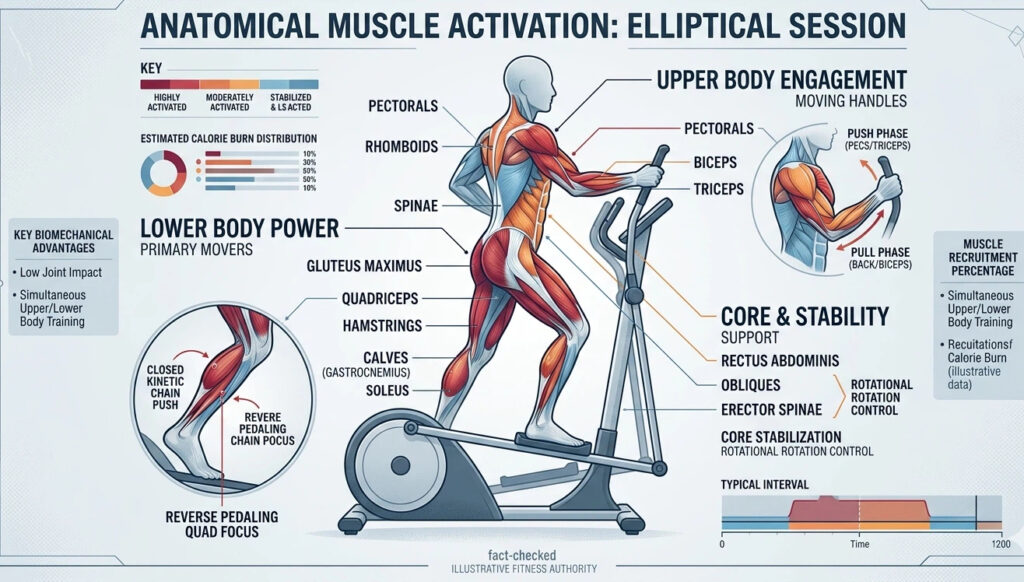
One of the most overlooked elliptical machine benefits is its ability to engage both the upper and lower body simultaneously. While treadmills and stationary bikes focus almost exclusively on the posterior chain and quads, the moving handles of an elliptical recruit:
- Upper Body: Pectorals, rhomboids, biceps, and triceps.
- Core: Obliques and rectus abdominis for stabilization.
- Lower Body: Glutes, hamstrings, and calves.
When distributed across the entire body, the perceived exertion is often lower than the actual caloric burn, allowing you to work harder for longer periods.
High-Efficiency Caloric Expenditure
If weight loss is the objective, the elliptical machine benefits are statistically significant. Depending on body weight and resistance levels, an average user can burn between 600 and 800 calories per hour.
By increasing the incline and resistance, you can trigger a higher Metabolic Equivalent of Task (MET). This makes the machine an ideal tool for HIIT (High-Intensity Interval Training), which promotes the “afterburn effect” or Excess Post-exercise Oxygen Consumption (EPOC).
Cardiovascular Health and VO2 Max Improvements
Consistent use of an elliptical trainer strengthens the heart and lungs, directly improving your VO2 max (the maximum amount of oxygen your body can utilize during exercise).
Research suggests that the heart rate response on an elliptical is comparable to running, meaning you get the same “engine-building” results without the mechanical wear and tear of the pavement. This is a critical elliptical machine benefits factor for long-term longevity and stroke prevention.
Targeting the Glutes: The “Incline” Advantage
Many modern ellipticals feature an adjustable ramp or incline. This mechanical adjustment shifts the focus of the workout. A higher incline places a greater demand on the gluteus maximus and hamstrings, mimicking the movement of climbing stairs or hiking uphill.
This versatility allows users to switch from a standard cardio session to a targeted lower-body sculpting routine with a single button press.
Functional Balance and Bone Density
While it is low-impact, using an elliptical is still a weight-bearing exercise. Unlike swimming or cycling, weight-bearing movements are essential for stimulating bone mineral density, which is vital for preventing osteoporosis.
Furthermore, the standing position requires constant micro-adjustments from the core and stabilizer muscles, which enhances overall functional balance and proprioception.
Versatility in Training: Forward and Reverse
A unique mechanical elliptical machine benefits is the ability to pedal in reverse. Retro-pedaling shifts the biomechanical load to the quadriceps and provides a different stimulus to the knee extensors. This is frequently used in physical therapy to balance muscle recruitment and prevent the “quad-dominance” often seen in runners.
Safety and Ease of Use
Compared to a treadmill, where the moving belt dictates the pace (often leading to trips or falls), an elliptical is user-powered. The machine stops when you stop. This makes it an incredibly safe option for seniors or those with balance disorders. The fixed path of motion also ensures that users maintain proper form, even when fatigued.
Space and Maintenance Efficiency
For home gym owners, the elliptical machine benefits extend to logistics. High-quality ellipticals generally have a smaller footprint than treadmills. Mechanically, they often require less frequent maintenance because they lack the high-friction “deck and belt” system found in running machines.
Mental Health and Consistency
The ability to customize a workout—switching between handles, changing resistance, or following a virtual trail—reduces the “boredom barrier” of cardio. Consistency is the most important factor in fitness, and the variety offered by the elliptical encourages long-term adherence.
Authority Reference: Harvard Health notes that elliptical training is a top-tier choice for maintaining fitness levels without the risk of overuse injuries common in high-impact sports. Harvard Health: Calories burned in 30 minutes
Elliptical vs. Treadmill: A Quick Efficiency Comparison
| Feature | Elliptical Machine | Treadmill |
| Joint Impact | Extremely Low | High to Moderate |
| Muscle Group | Full Body (Upper + Lower) | Primarily Lower Body |
| Safety | High (User-controlled) | Moderate (Motor-controlled) |
| Versatility | Forward & Reverse | Forward Only |
| Calorie Burn | High (High Perceived Comfort) | High (Higher Perceived Effort) |
FAQ
Is 30 minutes on the elliptical enough?
Yes. 30 minutes of moderate-to-high intensity on an elliptical can burn approximately 300–400 calories and significantly improve cardiovascular health if done consistently 3-4 times a week.
Does the elliptical help lose belly fat?
While you cannot “spot-reduce” fat, the high calorie-burning potential of the elliptical machine benefits helps create the necessary caloric deficit for overall fat loss, including the abdominal area.
Is an elliptical better than walking?
In terms of caloric expenditure and muscle engagement, yes. The elliptical engages the upper body and allows for higher resistance levels that walking on flat ground cannot provide.
Can seniors use an elliptical safely?
Absolutely. Its low-impact nature and handle-assisted balance make it one of the safest cardio options for maintaining mobility and bone density in seniors.