
If you’ve been grinding away for 45 minutes every day but your physique hasn’t changed in months, you haven’t hit a willpower wall—you’ve hit a biomechanical one. Most trainees treat their cardio as a mindless “flat-plane” activity, unaware that the body is a master of adaptation. To force growth and fat loss, you need to introduce mechanical disadvantage. This is where the adjustable incline elliptical transforms from a standard gym machine into a precision sculpting tool for your posterior chain.
The mistake most fitness enthusiasts make is relying solely on resistance. While turning up the tension makes the workout “harder,” it doesn’t necessarily make it “better” for specific aesthetic goals like glute lifting or quad definition. By changing the ramp angle, you shift the primary load from a cardiovascular strain to a targeted muscular stimulus.
Table of Contents
How an Adjustable Incline Elliptical Changes the Game
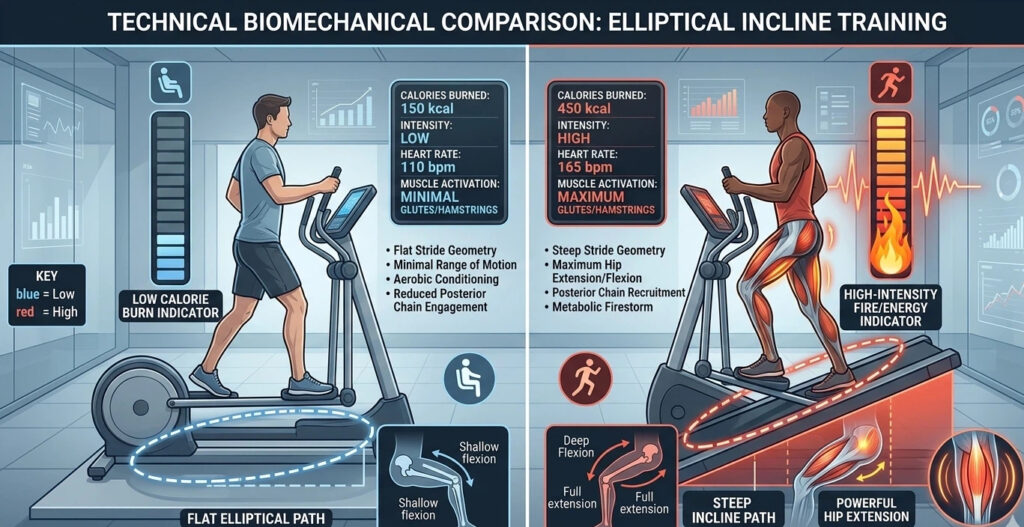
When you step onto an adjustable incline elliptical, you are essentially changing the geometry of your gait. On a standard, flat elliptical, the motion is a long, shallow oval. This is great for low-impact steady-state cardio, but it lacks the hip extension required for serious muscle hypertrophy. Your body quickly finds the path of least resistance on a flat plane, leading to that frustrating plateau.
As you increase the ramp, the elliptical stride geometry shifts from a horizontal slide to a vertical climb. This change in the “angle of attack” forces your joints to move through a larger range of motion. Specifically, the higher the incline, the more acute the angle at your hip becomes during the drive phase. This mechanical shift is the primary reason why a high-quality adjustable incline elliptical is superior for those looking to break through a fitness plateau.
Precision Sculpting: Target Different Muscle Groups with Incline
One of the most powerful features of these machines is the ability to target different muscle groups with incline settings. You aren’t just moving faster; you are changing which muscles are doing the heavy lifting. This versatility is what makes the adjustable incline elliptical a staple in professional training facilities.
- Low Incline (0% – 10%): This mimics a cross-country skiing motion. The focus is primarily on the calves and quadriceps. It is excellent for “active recovery” or building aerobic capacity.
- Moderate Incline (10% – 20%): This introduces more knee drive, increasing the load on the quads and the core as you stabilize your upright posture.
- High Incline (20% – 35%): This is the “danger zone” for body fat. It mimics a steep hill climb, forcing your body into deep hip flexion. This is widely considered the best elliptical incline angle for glute isolation, as the gluteus maximus must fire harder to achieve full hip extension at the top of the stride.
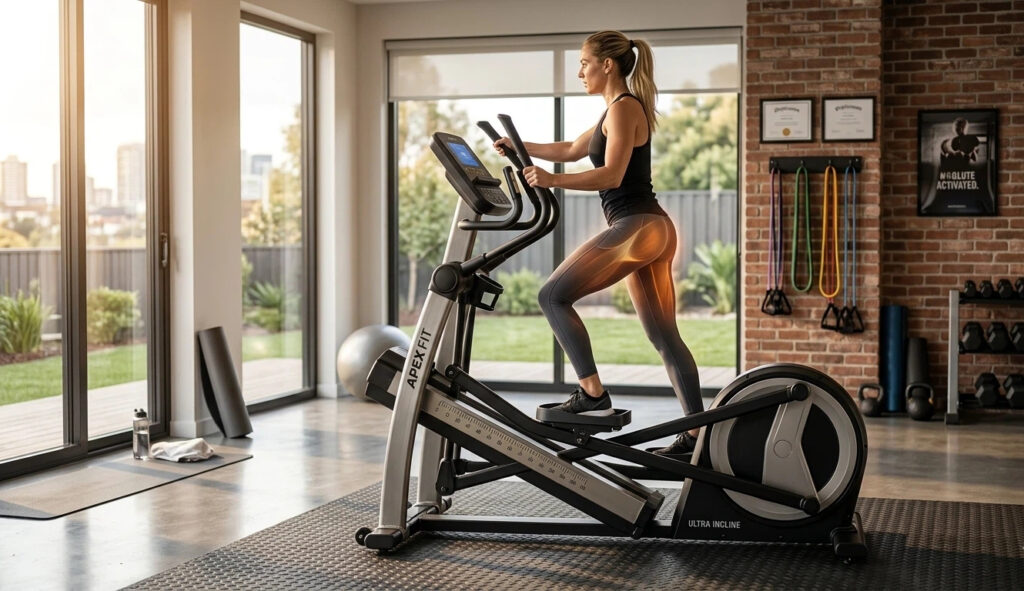
According to research published by the American Council on Exercise (ACE), increasing the incline on cross-training equipment significantly spikes the electromyography (EMG) activity in the glutes and hamstrings compared to flat-surface exercise. You can explore their findings on lower-body muscle activation here: ACE Fitness Research.
Power Ramp vs Manual Incline for Elliptical Glute Activation: The Real ROI
If you are shopping for a machine, you will likely encounter two types of incline systems. The choice between power ramp vs manual incline for elliptical glute activation isn’t just about convenience—it’s about the integrity of your training session and how often you will actually use the feature.
A manual incline requires you to stop, get off the machine, adjust a lever, and get back on. This kills your heart rate, ruins your “Time Under Tension” (TUT), and breaks the flow of an adjustable incline elliptical workout. In contrast, a power ramp allows you to change the angle mid-stride. This is crucial for HIIT (High-Intensity Interval Training) protocols. Imagine sprinting for 30 seconds at a 30% incline, then dropping to 5% for a recovery walk without ever breaking your rhythm.
For serious athletes, the dynamic incline training vs flat plane pedaling experience offered by a power ramp is the only way to ensure consistent metabolic stress, which is the precursor to muscle growth.
Why the Metabolic Demand of Incline Training is a Fat-Burning Cheat Code
It’s a simple law of physics: moving a mass (your body) vertically requires more energy than moving it horizontally. The metabolic demand of incline training is significantly higher than flat training at the same speed. This is why a 20-minute session on an adjustable incline elliptical can often outperform an hour of flat walking.
When you use an adjustable incline elliptical, your heart rate stays elevated even at lower RPMs. This makes it an ideal tool for individuals who want the fat-burning benefits of a stair climber but without the jarring impact on the knee joints. By engaging the larger muscle groups of the lower body—the glutes and hamstrings—you are essentially turning your legs into a furnace that burns more calories both during and after the workout (the EPOC effect).
What to Look for in a Premium Adjustable Incline Elliptical
A high-end adjustable incline elliptical is built with a reinforced drive system to handle the increased torque of incline work. When the ramp goes up, the friction and gravity pull on the tracks increase significantly. Cheap machines often stutter, squeak, or feel “clunky” under this specific type of stress.
For those stuck in a rut, the transition to dynamic incline training vs flat plane pedaling provides the neurological novelty needed to restart progress. It challenges your balance, your core stability, and your “mind-muscle connection.” While a basic machine might get you moving, a sophisticated adjustable incline elliptical with a silent, electromagnetic drive system gets you results without the maintenance headaches.
Functional Strength and Posterior Chain Engagement
Modern lifestyle habits—long hours of sitting at desks—lead to “gluteal amnesia,” where the muscles of the buttock essentially stop firing correctly. Utilizing an adjustable incline elliptical promotes massive posterior chain engagement, which is vital for posture and lower back health.
As the ramp rises, the hamstrings and glutes are forced to take over the work from the quadriceps. This balance prevents “quad dominance,” a common cause of knee pain in runners and gym-goers. By strengthening the back of your legs on an adjustable incline elliptical, you are building a foundation of functional strength that carries over into your deadlifts, squats, and daily life.
Final Verdict
The technical reality is that your body is designed to climb. We evolved navigating hills and uneven terrain, not flat gym floors. The adjustable incline elliptical honors this evolutionary design by allowing you to simulate rugged terrain in a controlled, low-impact environment.
If you are tired of looking the same month after month, it is time to stop running in circles. By embracing the power of the ramp, you can target different muscle groups with incline settings and finally achieve the lower-body definition you’ve been working for.
Whether you choose a machine for the posterior chain engagement or the massive caloric burn, one thing is certain: once you experience the intensity of an incline, you’ll never want to go back to a flat workout again. Investing in a high-performance adjustable incline elliptical is, quite literally, the fastest way to level up your fitness and reclaim your results.
FAQ
Is the adjustable incline elliptical safe for chronic knee pain?
Yes. It is arguably the safest high-intensity tool available. The incline allows you to reach a massive heart rate without the high-speed “pounding” force associated with running.
What is the best elliptical incline angle for glute isolation?
Aim for 15% to 25%. At this range, the adjustable incline elliptical maximizes hip extension, which is the primary function of the gluteus maximus.
How often should I use the incline feature?
For fat loss, integrate incline intervals 3 times a week. The metabolic demand of incline training is high, so allow 24 hours for muscle recovery between steep sessions.
Can I simulate hill sprints on an adjustable incline elliptical?
Absolutely. Set the incline to its maximum and increase resistance for 30-second bursts. This is the ultimate way to trigger posterior chain engagement.